Post
Love Knot Bracelet Set – The Ancient Symbol of Unbreakable Devotion
Jun
The Love Knot Through History
The love knot — known by many different names across the diverse cultures and traditions that have independently developed and treasured it — is one of humanity’s oldest and most enduring symbols of romantic love and eternal commitment. In ancient Rome, the knot of Hercules was used to bind the sashes of wedding gowns as a symbol of the strength and permanence of the marital bond — a reference to Hercules’s legendary invincibility and the idea that a marriage, once made, should be as difficult to break as the knot of the greatest hero. In Celtic tradition, the interlaced knotwork that appears with extraordinary beauty in manuscripts like the Book of Kells and in the carved stone monuments of ancient Scotland and Ireland represents the interconnectedness of all life, the eternal cycle of birth and death and rebirth, and the unbreakable nature of true love as it persists through time and change. In Chinese decorative tradition, the elaborate decorative knot appears throughout art, architecture, and jewelry as a symbol of good fortune, love, and longevity. The Love Knot Bracelet Set honors this magnificent symbolic heritage with craftsmanship worthy of its weight.
The journey of the love knot through human history is a testament to the universal human need for symbols that capture what words cannot fully express. How do you say, in any language, that this love is forever? That it has no end and no beginning but simply is? That it will endure through separation, through difficulty, through the ordinary wearing-down of time? Words fail at the threshold of such declarations. But a knot — a simple, elegant, infinitely complex knot — speaks where words cannot. It says, without ambiguity: I am tied to you. This tie is strong. This tie is not meant to be undone.
Consider the ancient Roman bride on her wedding day. As she dressed, her family would tie a knot of Hercules — a specific, named knot with a specific, powerful association — in the sash of her gown. The groom, upon entering the bridal chamber after the ceremony, would untie that knot. The symbolism was layered and rich: the knot represented the virginity that the bride brought to the marriage, but more profoundly, it represented the strength of the bond being created. Hercules was the strongest of heroes, the one who could accomplish what ordinary mortals could not. A knot tied in his name could not be casually broken. The act of untying it by the groom was not an act of destruction but of transformation — the knot’s power passing from the bride’s family to the new husband, from one form of binding to another. This ritual persisted for centuries, a small but significant moment in which the couple acknowledged that their marriage was entering into a tradition far older and larger than themselves.
The Celtic tradition offers an even more elaborate visual language of knots. The endless knot, also known as the mystic knot, appears in Celtic art as a single continuous line that loops and weaves back on itself indefinitely, with no beginning and no end. This is the knot as eternity — a visual representation of the concept that love, like the soul, like the cycle of the seasons, has no endpoint. The line goes on forever, turning and crossing and returning, but never stopping. The Book of Kells, that extraordinary illuminated manuscript created by Celtic monks around the year 800, is filled with such knots — not merely as decoration but as sacred geometry, as visual theology, as a way of depicting divine and eternal truths in ink and pigment on vellum. To wear a Celtic love knot is to connect oneself to this thousand-year tradition of seeing the infinite in the finite, the eternal in the everyday.
In Chinese tradition, the decorative knot — often called the Chinese love knot or the endless knot — appears in art, architecture, and jewelry as a symbol of good fortune, long life, and lasting love. The Chinese knot is typically symmetrical, balanced, and intricate, reflecting the Taoist values of harmony and the complementary nature of opposing forces. A love knot given between lovers or between friends carries the wish that the relationship will be as balanced, as harmonious, and as enduring as the knot itself. The red thread of fate — a related concept in East Asian folklore — holds that the gods tie an invisible red cord around the ankles of those who are destined to meet and love each other. That thread may stretch and tangle but never breaks. The love knot is the visible version of that invisible thread: a conscious acknowledgment of a destiny that the wearers actively choose to embrace.
Design Inspired by Heritage
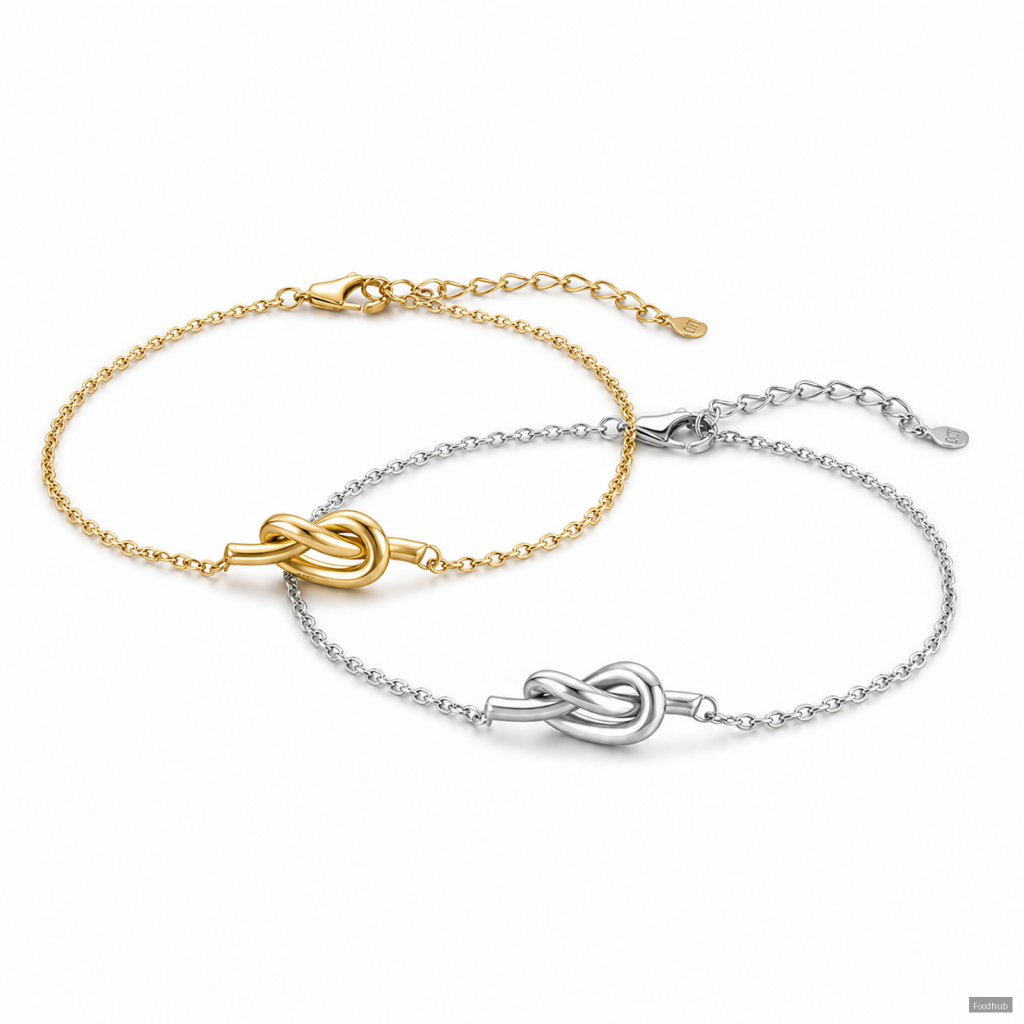
The Love Knot Bracelet Set takes the rich visual heritage of the love knot and renders it in fine jewelry with contemporary sensibility and the highest level of technical precision. The knot motif at the center of each bracelet is crafted with meticulous attention to its form — the loops and crossings of the knot are clearly legible and immediately recognizable as the specific symbol they represent, while the overall execution has a polished, sophisticated finish that places it firmly within the tradition of fine jewelry rather than craft or folk adornment. The knot is crafted in polished sterling silver or 14-karat gold fill, both options offering excellent durability, a quality finish, and a precious metal presence that matches the weight of the symbol they render.
The decision to offer the Love Knot Bracelet Set in both sterling silver and gold fill is an acknowledgment that different couples have different tastes, different budgets, and different relationships to precious metals. Sterling silver offers a cool, bright, contemporary look that complements both casual and formal wear. It is durable, hypoallergenic, and maintains its beauty with minimal care. Gold fill — not to be confused with gold plating — offers the warmth and richness of solid gold at a fraction of the price. Gold fill is created by bonding a thick layer of gold to a base metal core under heat and pressure, resulting in a product that can last for decades without wearing through. Both options are excellent choices; the decision is purely a matter of personal preference and style.
The bracelets themselves are designed to be worn individually or as a matching set. Each bracelet features the love knot motif suspended from a fine chain, with an adjustable clasp that accommodates a range of wrist sizes comfortably. The knot pendant is sized to be noticeable without being overwhelming — present enough to be seen and recognized, subtle enough to work with a variety of other jewelry pieces. This balance is intentional. The love knot is a symbol of commitment, but commitment does not need to announce itself loudly. It is enough that the wearer knows, and perhaps those closest to the wearer notice. The rest of the world does not need to understand. The knot speaks its silent language to those who have ears to hear.
The Metaphysics of the Knot
There is something philosophically rich and genuinely interesting about the knot as a symbol of love. A knot is, by definition, a point of increased complexity in an otherwise simple line — a place where the line folds back on itself, creating something denser, stronger, more intricate, and more resistant to separation than the simple, uncomplicated line was on its own. This is a remarkably precise and accurate metaphor for what love does to two individual lives when it genuinely and deeply connects them: it creates a point of connection, of interweaving, of mutual complexity that makes each person’s life richer, more resilient, and more complete than it was in its simpler, pre-love form. The knot that binds is the same knot that strengthens, and the strengthening is inseparable from the binding.
Consider a single thread. It is easy to break. Pull it taut and snap it with your fingers; it offers minimal resistance. But knot that same thread to another thread — tie them together firmly — and something changes. The knotted thread is stronger than the unknotted thread. The point of connection is the point of greatest strength, not the point of greatest weakness, because the knot distributes tension across multiple segments and multiple directions. This is the paradox of love: the place where you are most vulnerable — where you have opened yourself to another person, where you have allowed your life to become intertwined with theirs — is also the place where you become strongest. The love knot captures this paradox beautifully, making visible the invisible truth that love’s binding is also love’s strengthening.
The knot also resists easy untying. This is not a flaw but a feature. A love that can be undone with a single tug is not a love worth the name. True love, deep love, the kind of love that has been tested by time and difficulty and disappointment and forgiveness — that love is knotted tightly. It can be untied, perhaps, with patience and effort and pain, but it does not unravel by accident. It holds. It endures. It keeps its shape even when pulled and strained. That is the knot’s promise: not that the relationship will never face difficulty, but that it is built to withstand difficulty. That it is strong enough to hold.
When to Give the Love Knot
The Love Knot Bracelet Set is appropriate and beautiful for a wide range of romantic and meaningful occasions, its symbolism adapting to each context with the flexibility of a truly powerful symbol. As an anniversary gift, it speaks of all the years that have already woven two people together and the years that stretch ahead, still to be knotted. As a Valentine’s Day gift, it declares the permanence of a love that goes far deeper than seasonal sentiment. As a gift for a new couple at the beginning of their story, it plants the seed of a beautiful and hopeful idea — that this relationship is worth committing to, worth tying yourself to with intention and hope.
For weddings, the Love Knot Bracelet Set serves as a beautiful alternative or complement to traditional wedding bands. Some couples choose to exchange love knot bracelets as part of their ceremony, then wear them alongside their rings as a daily reminder of the vows they have spoken. For commitment ceremonies, handfastings, and other alternative wedding traditions, the love knot is an especially appropriate symbol, resonating with the ancient Celtic practice of handfasting — a ritual in which the couple’s hands are literally tied together with cord to seal their vows.
For long-distance couples, the Love Knot Bracelet Set carries particular poignancy. The knot says: distance does not undo us. Miles cannot untie what love has tied. We are still connected, still bound, still strong. Some long-distance couples have made a practice of touching their bracelets at a predetermined time each day — a small, private ritual of connection across the digital divide. The bracelet becomes a bridge, a physical object that carries meaning across the empty space between them.
Bound Together Always
The Love Knot Bracelet Set arrives in a luxurious velvet-lined gift box with a beautifully printed card explaining the historic significance and cross-cultural resonance of the love knot symbol. Give the gift of the ancient, enduring, genuinely beautiful symbol of unbreakable devotion — give the Love Knot Bracelet Set. Because the greatest love stories are the ones in which two people decide, consciously and repeatedly, that the knot they have tied together is one they choose to keep. Because some ties, once made with love and intention, are made forever.
A Final Reflection: The Knot You Choose
The love knot is not a trap. It is not a snare, not a binding against one’s will, not a restriction on freedom. It is a gift — a voluntary offering of one’s own thread to be woven together with another’s. The knot exists because both people chose to tie it, and both people continue to choose to keep it tied. That choice, renewed daily, is the miracle. That choice, freely made and freely offered, is what transforms two separate threads into something stronger, something more beautiful, something that can hold. Wear the love knot not as a reminder of obligation but as a celebration of choice. You chose this. You keep choosing this. And that choice, freely repeated, is the most powerful force in the world.
